

At some time in Ancient Egypt’s history temples seem to have replaced pyramids as the Egyptian pharaoh’s preferred way of dealing with the gods.
The oldest surviving temple of some size dates back to the 12th Dynasty, which also is the last dynasty to have built pyramids of some size.
The forgotten capital
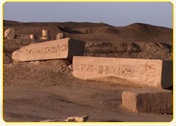
Tanis is like no other site in Egypt, and the journey getting there is very much a part of the total experience. So do not fall asleep. You will travel through the green and completely flat Nile Delta, and then, suddenly, weird brown mounds rise above the ground, where only a couple of simple huts mark the ruins of ancient Egyptian Temples and monuments of Tanis.
When you are there all by yourself, knowing that it was Egypt’s capital for more than 350 years, and that the main Temple of Tanis was among the largest ever built in Egypt, your imagination is truly stirred by the scale and history of these sacred Egyptian Temples.
Tanis has many fine statues, great reliefs, unusually many nilometers, and some royal tombs built according to patterns not used since the Old Kingdom mastabas, all surrounded by the remains of impressive Egyptian Temples that reflect the religious and architectural importance of the site.
Luxour - Hatshepsut
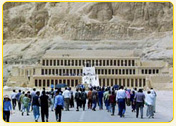
Hatshepsut is the only woman to rule Egypt as a pharaoh, but this was achieved through clever use of coalitions and marriage. She was the daughter of Tuthmosis II, married to Tuthmosis III, and after his death, she claimed effective power by marrying the infant Tuthmosis IV. Her Egyptian Temples, located at the foot of the Theban hills, are among the most effectively designed structures of all of Egypt. This temple, while employing most of the grand effects of common Ancient Egyptian Temples, makes use of open space and contrasts with nature.
Most of the area is based on the experience of arrival, with wide columned halls stacked on top of each other, and two ramps bringing you up to the second floor, which is deliberately dwarfed by the huge hills in the back. The temple almost continues into the hills, which are not just any hills. They mark the other side of the Valley of Kings, the place where kings built tombs in the form of shafts connecting to the underworld.
In modern times, enough of the Egyptian Temples remain to impress visitors, helping even the most insecure photographer make fine shots. However, two important parts are gone, and you should allow yourself a moment to imagine how the Ancient Egyptian Temples may have looked in their prime.
Luxour - Karnak
Temple of Mentu
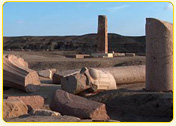
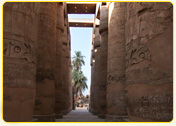
The Temple of Mentu is seriously closed to visitors, but with a promise of not entering, you will possibly be allowed to take it in from the top of the mound dividing it from the Precinct of Amon. There is not much to see, but the gate is in excellent condition, showcasing the durability of Ancient Egyptian Temples.
The Temple of Mentu was not a lone temple. Within what seems like one structure, there were also small Egyptian Temples dedicated to Amon, Harpre, and Osiris. The Temple of Mentu was built by the command of Amenophis III of the 18th Dynasty (15th century BCE), and some of his cartouches have survived, offering visitors a glimpse into the architectural achievements of Ancient Egyptian Temples from that era.
Cities - Abu Sir
5th Dynasty Pyramids
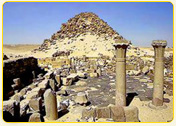
The complex at Abu Sir is a necropolis from the 5th Dynasty and was in use for a fairly short period of time, just about 70 years. The importance of the area may have started sometime after 2500 BCE and ended before 2420 BCE. Younger than the pyramids of Giza, one gets surprised by the fact that the Egyptian Temples and pyramids here are so much smaller compared to the grand Ancient Egyptian Temples like those at Giza.
All in all, there are 3 standing pyramids, plus the remains of a handful of others. The Pyramid of Neferikare is the largest, with a height of 72 meters. The name Abu Sir comes from the Egyptian “Per Wsir,” which meant “Place of Osiris,” linking this site to the Ancient Egyptian Temples dedicated to the gods. The remains of these Egyptian Temples at Abu Sir provide an essential piece of Egypt’s rich architectural and religious history.
Cities - Kom Ombo
Twin Temple
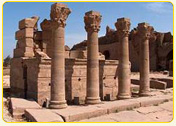
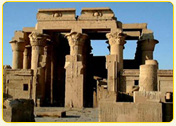
Kom Ombo used to be an important caravan town – it was here that the 40-day caravans from Sudan or Nubia met the caravans carrying gold from the mines in the eastern desert. In Ptolemaic times (from the 3rd century BCE until the early 1st century CE), Kom Ombo was also the training ground for army elephants. The Egyptian Temples in Kom Ombo reflect the town’s strategic importance during this era.
Today, only a small town remains, noted for its sugar production and the many Nubians who settled here after their villages were inundated by the Aswan High Dam in the 1960s. The Ancient Egyptian Temples of Kom Ombo, which are still standing, continue to draw visitors who are interested in the rich history of the site and its connection to Egypt’s past, offering a glimpse into the grandeur of the Egyptian Temples from the Ptolemaic period.
Cities - Abu Simbel
The frightening temple
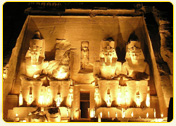
The isolation of the temple of Abu Simbel is part of the reason for its existence. Here, at the point where Nubia ends and Egypt begins, Pharaoh Ramses II decided about 3,300 years ago to erect an Egyptian Temple with a shape and dimensions designed to intimidate invaders from the south. Four 20-meter high statues of himself stare towards any potential invader, signaling the power they would face if they continued north.
For the brave who dared to enter, large wall decorations depict Ramses killing Hittites, Nubians, and Libyans — the main enemies of Ancient Egyptian Temples and Egypt in those days. While the temple was officially erected in veneration of the major gods Amon and Re-Harakhte, Ramses was an unusually immodest Pharaoh. If anything, this Egyptian Temple indicates that he himself is larger than any god, a claim to divinity granted by the very gods he overshadows. The Ancient Egyptian Temples at Abu Simbel, in their grandeur and symbolism, reflect Ramses’ extraordinary self-importance and his desire to immortalize his power.