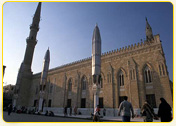


Islamic - Mosques
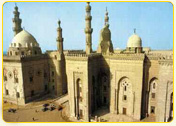
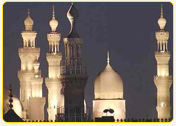
Cairo is known as the City of 1,000 Minarets because of its many mosques. Many of these mosques are open to visitors, and in fact, Cairo has an ongoing program for the restoration of ancient mosques, a few of which rank as some of the oldest to be found in the world. Certainly, some are the grandest to be found anywhere, making them a highlight on an Islamic tour in Egypt.
Many visitors to Egypt, who arrive with even a meager interest in this architecture and a slightly open mind, and particularly those with a creative streak, will be awestruck by their beauty and design. Yet, unfortunately, many western visitors may completely bypass these wonders of a very different civilization. For those who do venture into an ancient mosque or two during their Islamic tour in Egypt, their lack of knowledge regarding this art form will often result in a short, cursory examination lacking substance.
Mosques, and Islamic architecture in general, unlike western architecture, varies more between different geographical regions than it does between historical ages. Scholars tell us that this is at least due in part to the rapid initial spread of Islam, as opposed to Christianity, which was suppressed during its first several hundred years. Christianity had the opportunity to develop more common architectural styles in its formative years, while Islam spread through a vast territory quickly where the use of local building material and ideas by local craftsmen and architects created distinguished regional variants.
Yet, because Egypt has seen many influences from numerous different ruling empires, including Abbasid, Fatimid, Ayyubid, Mamluk, Ottoman, and others, and because Cairo specifically is a city of the world, Egypt offers a fair overview of mosque styles. Furthermore, its mosques date from the earliest periods of Islam up to and including modern varieties, making it a fascinating stop on an Islamic tour in Egypt.
Some mosques in Egypt, particularly in Cairo, are actually complexes that include other structures not typically found attached to other mosques. For example, many mosques include an Islamic school facility, called a madrasa. Others may have mausoleums and tombs, and even hospitals (maristan), along with other structures within the complex.
Other mosques may be located in strange places. There is a mosque (Abu Al-Haggag Mosque), which creates a rather strange appearance inside the Temple of Luxor in Upper Egypt. In the Sinai, a Fatimid mosque is incorporated into the famous St. Catherine’s monastery, adding a unique touch to your Islamic tour in Egypt.
Egypt has some very notable, as well as important mosques, some of which may be visited while others are not open to tourist visits. While most of the tourist mosques are found in Islamic Cairo, the oldest of them all, the Amr Ibn El-Aas Mosque, is located in Coptic (Christian or Old Cairo) and may be visited, while the Al-Azhar Mosque, the location of the world’s oldest university and one of the most influential mosques in Islam, is not a tourist facility.
About Mosques - Their Concept
Although Christians, Jews, and Muslims worship the same God and have their roots within the same religious history, the concept of a mosque is very different from that of a Christian church, for example. While modern, moderate Islamic states such as Egypt function in a somewhat modified manner, traditionally there is no separation between religion and state as is typical in the Christian world. In fact, the leader of a mosque in ancient times was very often also the governor or political ruler. Within this context, mosques theoretically serve as both a place of worship and a political forum, which is an important element to understand on your Islamic tour in Egypt.
While modern political decisions in Egypt appear somewhat secular, Islamic leaders often make political statements. Their voices are needed and welcomed by politicians to substantiate their agendas. Mosque leaders, called imams, not only lead the congregation in prayer but also frequently discuss matters of state during the Friday prayer sessions, adding a unique political and cultural dimension to any Islamic tour in Egypt.
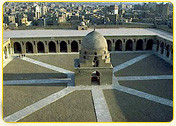
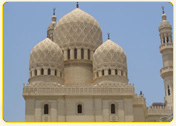
Basic components of a Mosque
The Demarcated Space
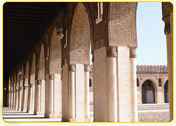
Prayer is an essential element of Islam, and the demarcated space allows a place for congregational prayer. In formal mosques, the demarcated space is almost always partially roofed and partly open to the sky. The covered prayer hall, or sanctuary (haram), usually varies relative to the size of the open courtyard (sahn). The courtyard is most often surrounded on three of its sides by colonnades, or arcades (riwags), with the fourth side opening into the covered sanctuary. On an Islamic tour in Egypt, visitors can observe this architectural design, where the prayer hall, which is typically rectangular or square, may take the form of a hypostyle hall with its roof supported by a number of evenly spaced columns.
In this design, a system of horizontal beams known as architraves, or alternatively, a system of arches, supports the ceiling. In other designs, the roof may consist of a single large dome on pendentives (one of the greatest contributions made by Islam to architecture), or instead, by one or more smaller domes, which are common features in mosques you’ll encounter on your Islamic tour in Egypt.
The size and proportion of the covered area versus the open courtyard depend on both the size of the congregation and the climate of the region where the mosque is located. Obviously, in wetter or colder climates, a smaller open courtyard would be required than, for example, in a city such as Cairo, where rain is scarce and the climate is usually moderate, even in winter—making Cairo a prime example for your Islamic tour in Egypt.
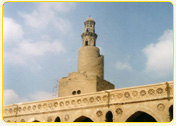
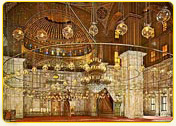
The Qibla Wall and the Mihrab
Right: Mihrab of the Sultan Hassan Mosque
Mosques throughout the world have a standard orientation. Within the prayer hall, one wall must face Mecca, the direction in which Muslims should face to pray. This wall is called the qibla wall, and at its midpoint is a niche or recess that constitutes the central and most decorated feature of any mosque, known as the mihrab. On your Islamic tour in Egypt, you’ll see how the mihrab typically takes the layout of a Roman niche, with a semicircular recess arched at the top.
It should be noted that the mihrab is not considered a sacred element of the mosque. Rather, it prescribes the sacred direction for prayer toward Mecca. When in prayer, Muslims will form row upon row, each parallel to and facing the qibla wall. Exploring this feature is an important aspect of the architectural beauty you’ll discover during your Islamic tour in Egypt.
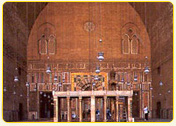
The Minbar
The minbar is essentially the Islamic equivalent of the pulpit and is always located to the right of the mihrab. It takes the form of a staircase leading to a small platform from which the imam leads prayers and also delivers the oration (khutba), which occurs on Fridays and may include both a sermon and a political message. On your Islamic tour in Egypt, you’ll observe how the minbar plays a central role in mosque architecture, symbolizing the importance of the imam’s leadership.
An imam may be defined as any adult male who leads a congregation in prayer. In actuality, the imam usually leads the prayers not from the platform at the top of the minbar, but from a step below. This is because the platform itself is symbolically reserved for the Prophet Muhammad, highlighting the deep respect and reverence for the Prophet, which you’ll learn more about during your Islamic tour in Egypt.
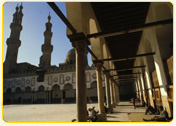
Minbar displayed in the Islamic Museum, Cairo
The minbar may vary in height depending on the congregation’s size, as it is simply to provide an elevated platform meant to allow the congregation to more easily hear the iman’s words. Depending on the size of the congregation, the minbar may have only a few steps, or may be truly monumental, though in very small mosques, there may be no minbar at all. The minbar may, or may not have handrails leading up the staircase to the platform. The small platform is often covered with an attractive shape, such as a cupola style roof.
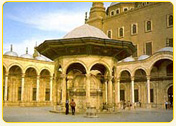
Minbar in the Muhammed Ali Mosque, Cairo
As a side note, in historical times, the minbar was used for the coronation, or inauguration for a new caliph, a political ruler.
The Dikka
The dikka is a raised platform from which the respondents (qadi) repeat the ritual postures of the imam and speak the responses so that the stages of prayer may be transmitted to larger congregations. For those familiar with the Greek Orthodox Church, the qadi is not unlike the role of the cantor and chorus. On your Islamic tour in Egypt, you may visit mosques where the dikka is located within the covered sanctuary or, depending on the climate and the size of the congregation, in the open courtyard. Regardless, it is always aligned with the position of the mihrab.
The dikka usually takes the form of a wooden, “single-story platform” accessible from its own staircase, which is an interesting architectural feature to explore during your Islamic tour in Egypt.